

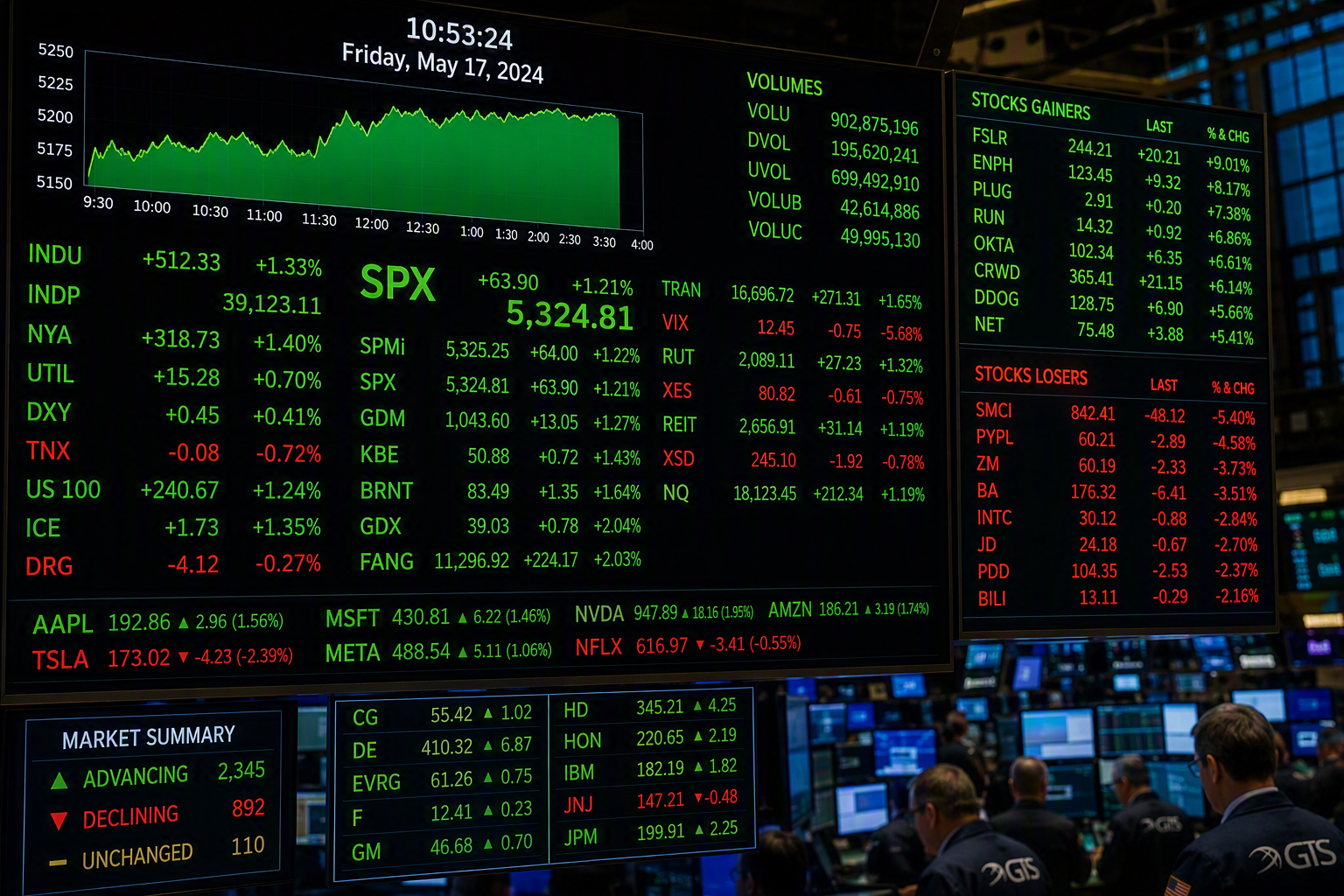
Stock markets reaching all-time highs can feel both reassuring and unsettling. On the one hand, rising markets are a sign that long-term investments are working. On the other, new highs can prompt the understandable questions: is now the wrong time to invest, or the right time to take some money off the table?
This feeling is entirely natural. Long-term savings are invested to protect – and hopefully grow – purchasing power. When markets have already risen, it can feel intuitively sensible to wait for a seemingly inevitable fall, or lock in recent gains before they disappear. Of course, it makes little sense to be invested right before a downturn. Buy-low, sell high. Why buy when prices are already high?
Emotions and Timing Markets
However, the problem is that what can feel emotionally sensible is not always good investment idea. Moving in and out of markets requires getting two decisions right: a.) when to leave and b.) crucially when to get back in. An oft overlooked fact is that market bottoms are as difficult to predict as peaks and markets can recover just as fast as they can fall.
Such decisions are difficult enough once, and harder still to repeat successfully over a lifetime of investing. Few professional investors have demonstrated an ability to time markets consistently, even with teams of analysts, sophisticated systems and constant access to information.
Investing is a counter intuitive, our emotions working against us. Elation, greed, fear and panic can all step in at different points to tempt us to make damaging timing decisions with our investments – absolutely none of us are immune from it.
If going on gut-instincts alone, I would have sold my investments about two years ago – over which time global stock markets have risen by over 35% (1). Every time we make a big new investment for a client, I worry markets are going to fall straight after. But we practice what we preach and we know to ignore those thoughts and not to try and second guess the process (or markets)!
How high?
Furthermore, stock markets reach record highs all the time. It isn’t unusual for them; it’s the whole purpose of investing. This is also different to assets where you’re speculating on price movements alone (e.g. commodities), which can go a long-time between market highs.
Markets rise over time because companies innovate, are profitable, reinvest capital and adapt to a changing world. If markets are expected to deliver positive returns over the long run, then new highs should be expected along the way. In fact, since 1990, developed stock markets have hit highs over 650 times, as the chart below demonstrates.
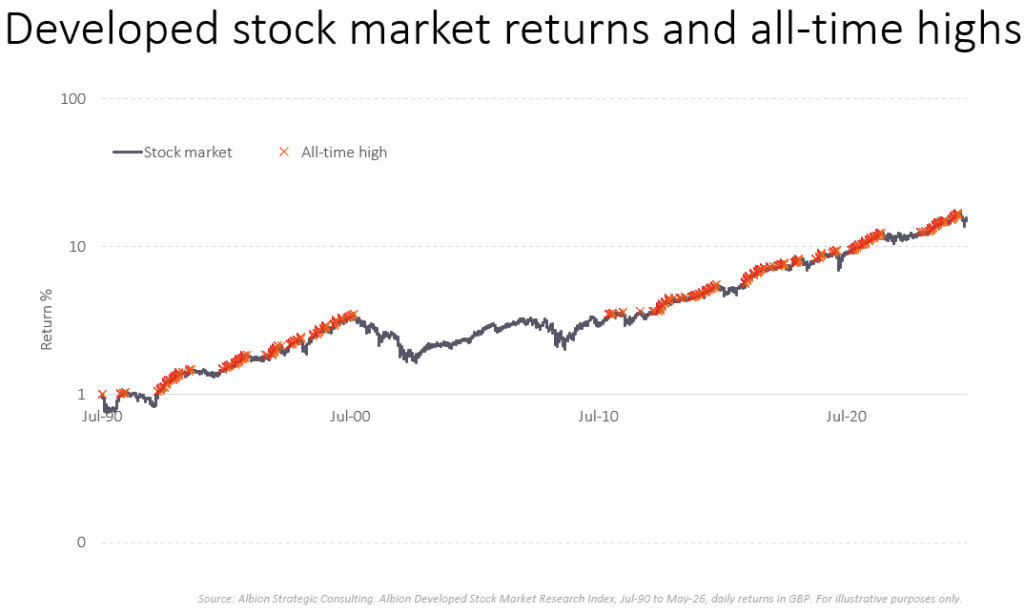
The news headline that ‘markets hit an all-time high’ should be taken with nothing more than a shrug of shoulders. It’s normal, it’s how markets work. They rise more days, weeks, months, years and decades than they fall.
Because of this (and the fact market predictions are near impossible), the rationale cause of action is to have all long-term assets (i.e. not those you may need over the short term) invested at all times.
Evidence
There has also been research on the outcomes of investing at market highs. Such research from JP Morgan (2020) demonstrated – perhaps counterintuitively – that average returns from investing in the S&P 500 index (the largest 500 stocks in the US) from January 1988 would have yielded better results by investing at market highs rather than on a randomly chosen day.
Investing on a randomly selected day would have led to a positive return in the next 12 months 83% of the time. Investing on the day of an all-time high would have led to a positive 12-month return 88% of the time. The average returns were also higher when investing at market highs, over the subsequent 1, 3 and 5-years.
A similar piece by Bank of America Research Investment Committee also came to similar conclusions when looking at investing in the S&P 500 index over the past 50 years (1975-2025), with 1, 2 and 5 year returns slightly higher when investing at a record high, versus investing when markets were not at a record high.
While there is clearly no guarantee that stock markets will follow such outcomes over the next few years, it this does demonstrate that there should be no expectation of a worse outcome when investing at a market high, compared to any other point in time.
Conclusions
Market falls are to be expected when investing. They are also factored into your cashflow modelling process and assumed outcomes. Unfortunately, there is no reliable way to predict when these falls will happen, and stock markets reaching all-time highs provides no further insight either.
As is so often the case with investment conclusions, the answer is to invest in an appropriate, diversified portfolio in line with your financial requirements and tolerance to investment, and then to hold that portfolio with discipline, for the long term.
If you wish to discuss any element of your investments, please get in touch using the contact button below.
(1) As measured by the MSCI World Index, Total Returns, dividends reinvested (10/09/24 – 10/09/26)
Disclaimer:
This document should not be considered a recommendation to purchase or sell any particular investment. Care has been taken to ensure the accuracy of content, but no responsibility is accepted for any errors or omissions. We do not predict or guarantee the future performance of any individual security, investment, portfolio or asset class.