


Bonds are often the least understood part of an investor’s portfolio. Everyone knows how cash deposits work and what property investment entails. Most investors understand the basic principle of equity investment i.e. you are buying a part ownership of a company to benefit from the ongoing profits it makes.
With Bonds however, there is far more uncertainty about what they are, what they’re doing and their purpose. This is to an extent down to both the media and investment industry, for whom talking about equities is simpler (at least at a superficial level) and more exciting.
In fact, the global bond market is just as important as global equity markets, providing a huge amount of capital, with estimates(1) putting both at about $160 trillion at the end of 2025. This is also around 3 to 4 times greater than the total estimated value of all commercial property on the planet(2).
So what are Bonds then?
Very simply, they are an IOU. You lend someone money (usually a government or company) for a defined period of time and they pay you a set rate of interest and your capital back at end of term. Payments can be either conventional or inflation-linked; we will focus on the former here for ease.
Fundamentally, they are just like a fixed-term cash deposit. The interest is set in advance and you get your money back at the end of the term.
“That’s it?” you ask. Pretty much – there’s just one major difference. You can sell these fixed-term deposits to other investors. Clearly however, it is then only worth what someone will be willing to pay for it.
Let’s imagine you put £1,000 into a five-year fixed-term deposit account paying 4% AER interest for five years. But then the following day interest rates suddenly went up, so you could now earn 5% AER on such deposits; that fixed rate deposit you took would look a lot less attractive.
If someone was to buy that fixed term deposit from you the following day, they wouldn’t be willing to pay you the full £1,000 for it, because they would be earning 1% AER less than they could get on a new deposit themselves. To earn the same 5% AER they could get elsewhere, the maximum they would pay you for your fixed-term deposit would be £956.
With a traditional fixed-term deposit you can’t get your money back, you must leave it till the end of the term (although some do allow access subject to an interest penalty). With a bond, you essentially have the option of getting your money back earlier, but you must accept whatever price the market places on that bond at a given moment in time. This price will reduce when interest rates (commonly referred to as “yields” with bonds) go up, making your fixed rate look less attractive. Conversely, the attractiveness / price of your fixed rate bond will rise when interest rates (yields) go down.
You always have the option of holding the bond until maturity and collecting the interest and maturity payments agreed to at outset.
In the above examples, we have talked about a single bond holding. In reality, most investors will own a bond fund which holds hundreds of bonds, which the manager trades depending on market conditions. The above concepts still apply, they will just apply to the average position of all the bond holdings.
The arithmetic of bond returns
If you hold a (conventional) bond to maturity, you will get the prescribed interest (coupon) payments and the face value back at maturity. If you have no intention of selling the bond, the market price in the meantime makes no difference.
If we take the previous example of the £1,000 fixed term deposit; you would receive the £40 income per year and the £1,000 capital back after 5 years. No matter what the market prices that bond at in the meantime, you will still get those payments. It is the expected return relative to that new price that changes.
If the market suddenly prices that bond at £1,200 the day after you buy it, the expected return on that new £1,200 price would be zero – the total payments from the bond only equal £1,200. Conversely, if the market suddenly priced that bond at £956 the following day, the expected return on that price would be about 5% p.a.
In that scenario, the value (what you could sell it for) of your bond has fallen by £44 / 4.4% on the first day. However, the cash payments due haven’t changed. You will still receive those. They will just equate to 5% p.a. of the current price, rather than the 4% p.a. on the original £1,000 deposit.
That is essentially what has happened at points this year (and happened far more dramatically in 2022). The price of bonds has fallen, but the expected return moving forwards has increased. If you continued to hold the same bonds to maturity (again assuming no default), losses would be recovered.
The shorter the term (duration) of the bonds you own, the quicker losses will be recovered (ignoring any trades conducted by a fund manager that detract value). For owners of short-dated bonds, interest rate rises will be a positive over the medium to longer term, due to the benefits of higher interest rates.
Term & Credit Risk
Bonds come in many different forms, with very different expected return profiles and risk levels. Broadly, there are the two major determinants of risk (and return) on a bond.
‘Term Risk’ is just the technical name for what we’ve described above. The longer the date on the bond, the bigger the impact of expectations of future interest rates (and inflation). Also, the longer the term, the greater the uncertainty over the future.
‘Credit risk’ is the chance of the borrow not paying you back. The less credit worthy the borrower, the greater that risk. This is the same as with cash. The more risky the bank/building society, the more they will pay in interest to get customer deposits – as anyone whose compared rates on comparison sites will know. Or, as anyone who spent days queuing outside a Northern Rock branch in 2007 will have experienced.
You may argue that cash has the benefit of Financial Services Compensation Scheme (FSCS) Protection. However, that is dependent on the ability of the UK government to cover the cost of that protection – the risk of which is exactly the same as the credit risk of lending money to the UK Government through a bond (called a Gilt).
So why invest in Bonds?
Our view is that the main reason is to protect / buffer from falls in equity markets. Equities (company shares) have higher expected returns but can suffer falls in value sharper than many investors can either a) tolerate or b) afford. Bonds provide diversification against such risks. Being technical, it’s bonds low correlation with equity and property market falls – i.e. they don’t tend to happen at the same time.
The chart below shows the largest equity market falls in each calendar year
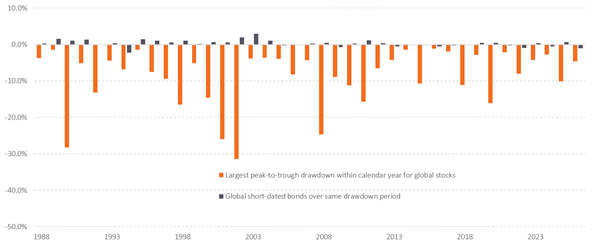
Source: Albion Strategic Consulting (3)
For this purpose, lower credit risk bonds are better. Severe equity market falls often occur during economic crises, when companies and some governments are financially stressed and there is greater uncertainty about their ability to repay their debt. Therefore, higher credit risk lenders debt can fall in value at the same time as equity markets, reducing their effectiveness for this purpose.
Our preference is also to invest in short-dated bonds (less than 5 years to repayment). This is in order to reduce fluctuations in value caused by interest rate / inflation expectations, providing a more stable value to rebalance in and out of equity markets.
You could hold cash for this role in your portfolio. However, bonds have historically provided higher returns over the long-term. Crucially, most bonds are also completely liquid – meaning they are always available or rebalancing into equity markets after falls and for funding any withdrawals / short-term cash needs you have. A diversified range of bond holdings is also not dependent on the solvency of a single bank or a small range of banks and/or the FSCS.
Summary
Bonds are a key asset class for most investor’s portfolios. You don’t need bonds right up until the point you really do. For investors in equity markets, they can reduce portfolio fluctuations in value (volatility) to a level they are comfortable with. The role of bonds is usually more important for those decumulating from their portfolios; providing liquidity to fund withdrawals (as well as funds to rebalance into equities) in prolonged market downturns.
Unlike with equities, the return on bonds (held to maturity) are known in advance (providing the borrower doesn’t default). At the time of writing, the UK Government needs to pay around 4.8% per annum to borrow money for periods of 2 – 5 years (and the US Government only around 0.2% p.a. less). Most large companies need to pay a little more than these governments (e.g. UK high street banks). That is the investors return in those bonds (4).
Therefore, the current future outlook for bonds (as at the time of writing) is to provide the discussed diversification / protection benefits, whilst providing an expected return of around 5% p.a. over the next few years.
(1) SIFMA (Securities Industry and Financial Markets Association) data.
(2) Statista estimates $38 trillion, with Savills putting it at $59 trillion – the differences likely reflecting a.) different definitions of commercial property and b.) the difficulty in valuing property.
(3) Data source: Albion Research Indices (see smartersuccess.net/indices for more details). Month-to-month data for Albion World Stock Market Research Index used to calculate peak-to-trough within calendar year. Albion Global Short Bond Index (0-5, GBP) represent bond returns over same period. Data in nominal terms, in GBP.
(4) Measured by a bond’s Yield-to-Maturity (YtM).
Disclaimer:
This should not be considered a recommendation to purchase or sell any particular investment. Care has been taken to ensure the accuracy of content, but no responsibility is accepted for any errors or omissions. We do not predict or guarantee the future performance of any individual security, investment, portfolio or asset class.